
Sushi Sho NYC Review: The Three-Michelin-Star Restaurant That Actually Lived Up to the Hype
After a string of supposedly world-class meals that left us wondering whether restaurant accolades had lost some of their meaning, we arrived at Sushi Sho with unusually complicated expectations.
We had recently returned to Eleven Madison Park, a restaurant we once adored, and left feeling that while it was still very good, it was no longer remotely the three-Michelin-star experience we remembered. And we had eaten at Jungsik, another New York restaurant with three Michelin stars, and similarly struggled to understand what elevated the experience into that rarefied third-star category.
And Michelin wasn't the only ranking system that had disappointed us. We traveled to Lima and ate at Central, named The World's Best Restaurant in 2023, and Maido, named The World's Best Restaurant in 2025. Both were interesting. Both were meals we were glad to experience. Neither felt like the best restaurant in the world.
So when Sushi Sho earned its third Michelin star in 2025, we were excited. But cautiously so.
At a certain point, when enough supposedly life-changing restaurants turn out to simply be very good restaurants, you start adjusting your expectations.
Then we ate at Sushi Sho.
Here are our honest thoughts.
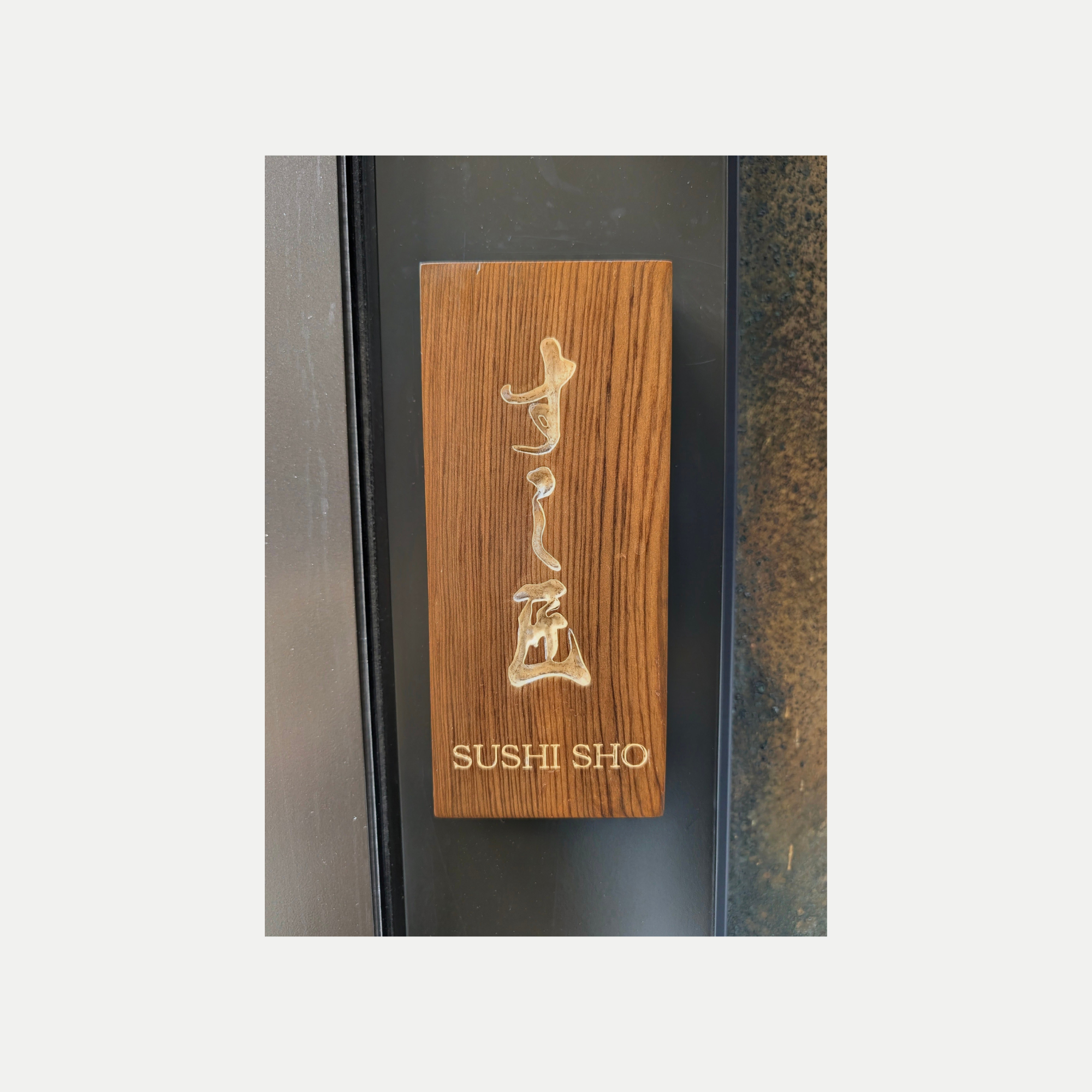
What Is Sushi Sho?
Sushi Sho is the creation of legendary Japanese sushi chef Keiji Nakazawa, who began working in restaurants at just 15 years old and trained across roughly 20 Japanese and sushi restaurants during his formative years. He eventually established Sushi Sho in Tokyo and became one of the most influential practitioners of Edomae sushi in Japan.
Nakazawa's reputation rests partly on his fascination with the techniques sushi chefs used before modern refrigeration. At a lot of luxury sushi restaurants, the implicit hierarchy is simple: find the freshest, most expensive fish possible and interfere with it as little as possible. Sushi Sho is more complicated.
Fish might be salted, aged, cured, marinated, fermented, cooked or otherwise manipulated to draw out a particular flavor or texture. Michelin specifically highlights Sushi Sho's extensive use of fermentation and the way the menu moves through fish, shellfish, vegetables and other ingredients.
Nakazawa also thinks extensively about the rice beneath the fish rather than treating "sushi rice" as one uniform base.
The result feels simultaneously traditional and experimental. Sushi Sho is deeply rooted in old techniques but it doesn't feel old-fashioned at all.
From Tokyo to Honolulu to New York
After building his reputation in Tokyo, Nakazawa made the unusual decision to leave Japan and open Sushi Sho at the Ritz-Carlton Residences in Waikiki in 2016. Then came New York.
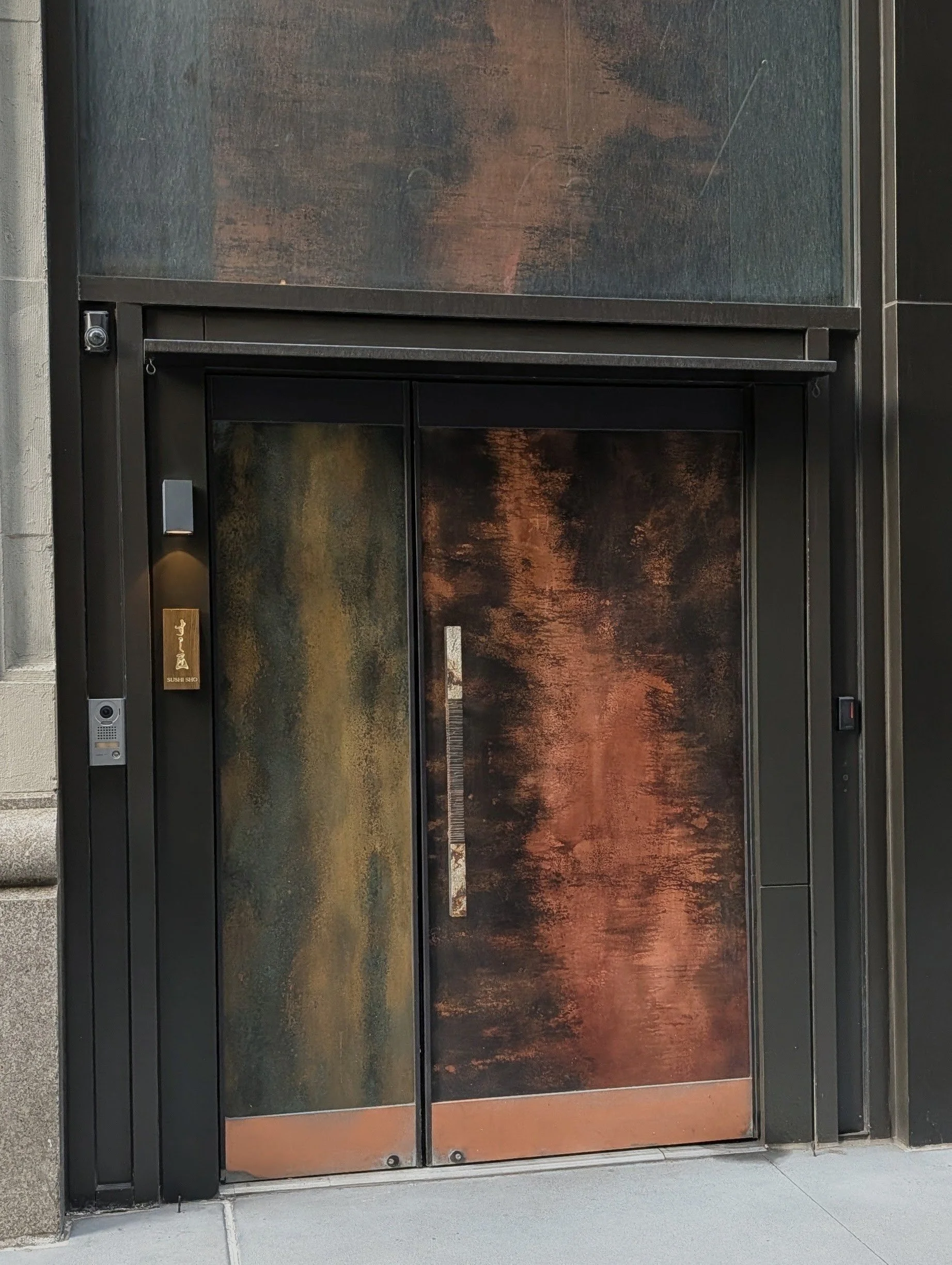
Sushi Sho quietly opened at 3 East 41st Street, across from the New York Public Library and just off Bryant Park, in 2024.
There isn't much fanfare outside. It doesn't look like the entrance to one of America's most ambitious restaurants.
Inside, the experience revolves around a tiny sushi counter where the chefs work directly in front of you.
In its first Michelin evaluation, Sushi Sho earned two stars, which is a remarkable feat. Then, in 2025, Michelin elevated it to three stars, making Sushi Sho one of the extraordinarily small number of restaurants Michelin considers worth a special journey.
This time, we agree.
A Note About the Photos
This will also look a little different from most of our restaurant reviews. Sushi Sho does not allow photography during the meal.
That isn't just an informal preference. Nakazawa has specifically explained that the policy is intended to keep guests immersed in the live experience of the sushi counter: watching the chefs' hands, hearing the knives, smelling ingredients being prepared and participating in the conversation happening across the counter.
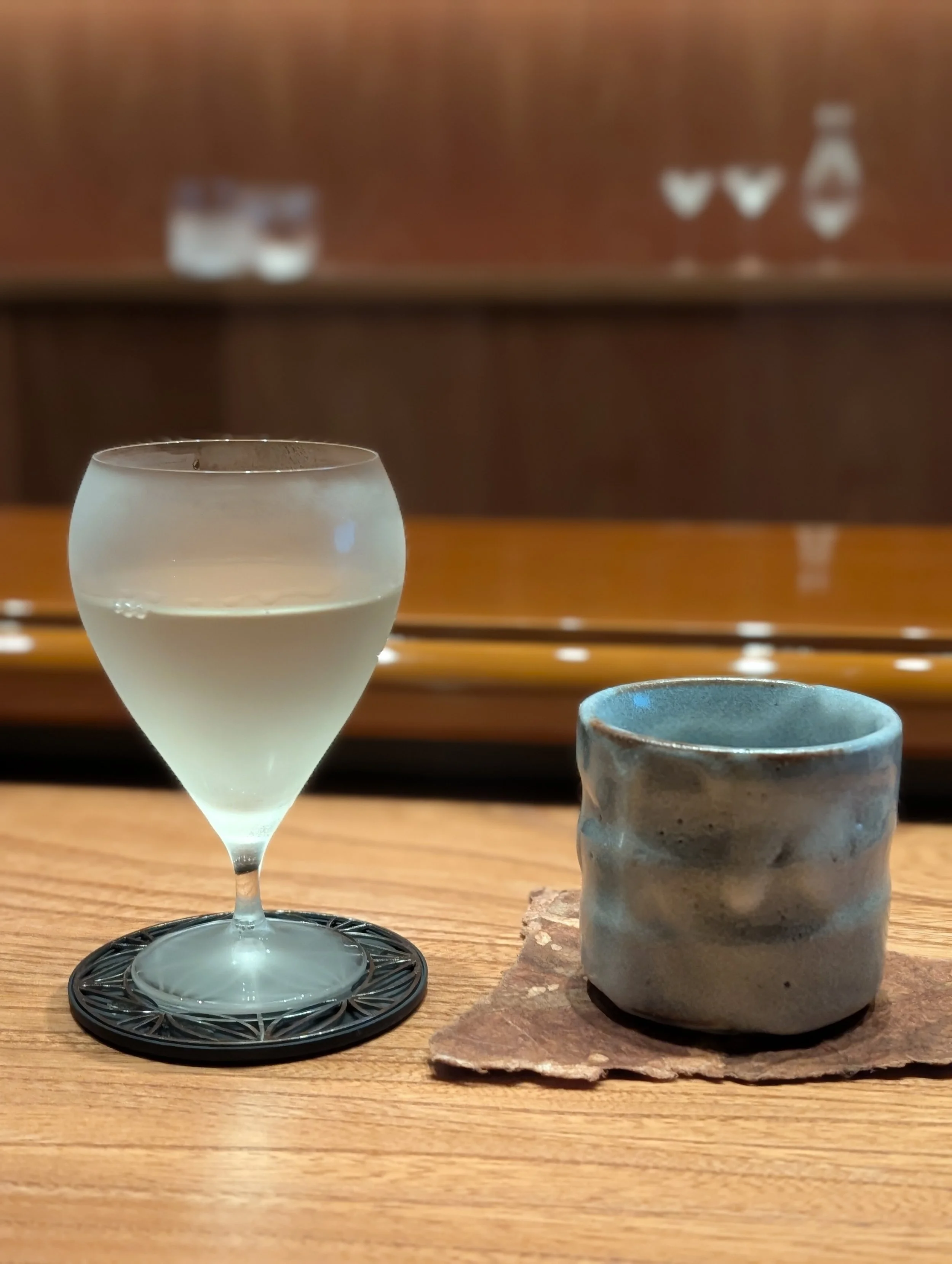
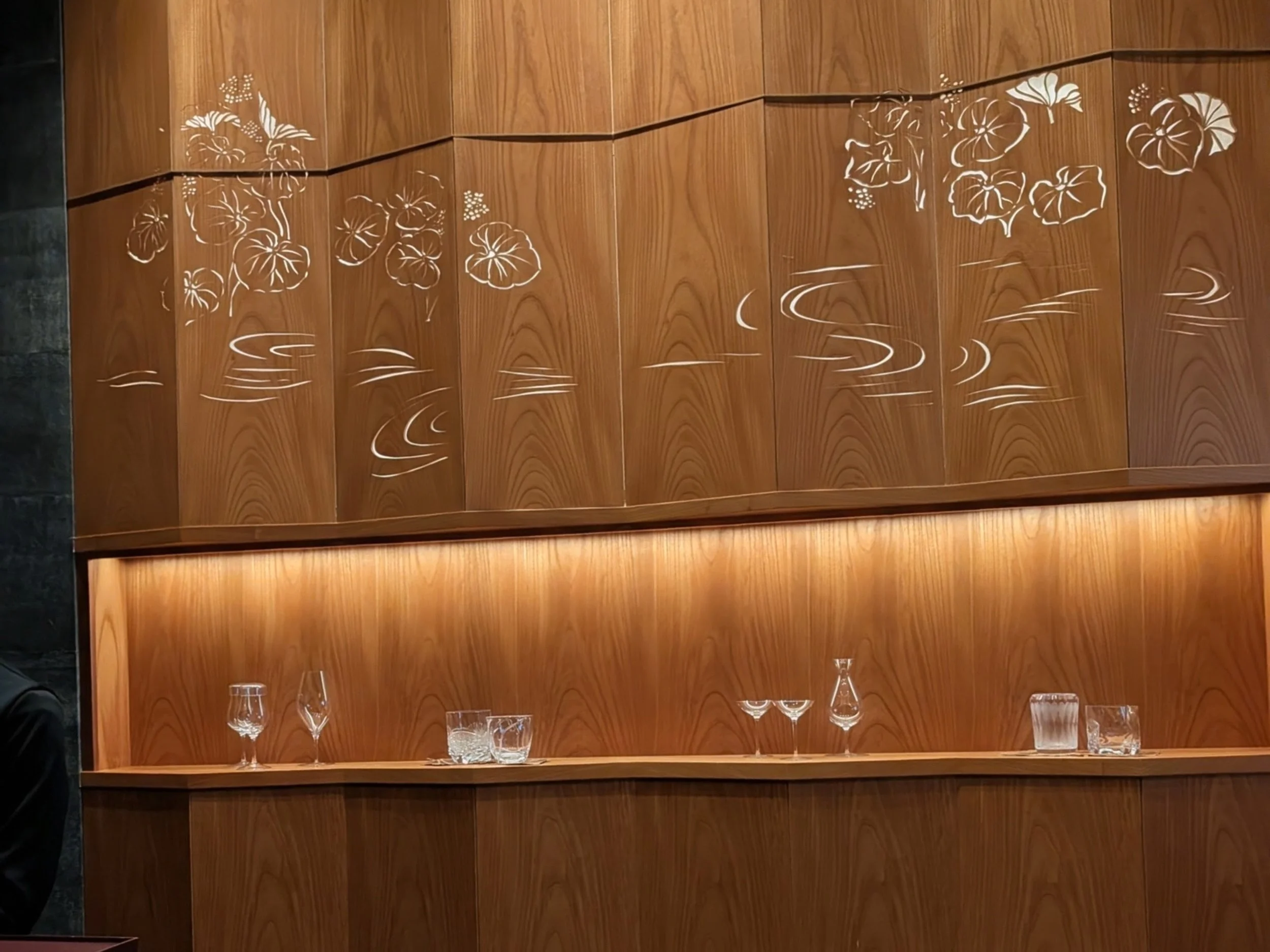
We of course respected the rule. So unfortunately, we don't have our normal parade of photos documenting every course. The photos in this review are limited to what we could capture outside of the actual dining experience, including the exterior and lounge.
After eating there, we understand the policy. So much of Sushi Sho's appeal is temporal.
A chef makes something.
He places it in front of you.
You eat it immediately.
Then it's gone.
There is something refreshing about experiencing a great meal without simultaneously trying to photograph it.
The Sushi Sho Menu Is Not a Normal Omakase
"Omakase" has become so ubiquitous in New York that the word has started to describe an enormous range of experiences. Sushi Sho doesn't follow the familiar formula particularly closely. Instead of simply serving a long progression of nigiri, the meal moves between otsumami, or small composed dishes, and sushi.
There are preserved ingredients.
Aged ingredients.
Different preparations of rice.
Different temperatures.
Different textures.
Fish that has been manipulated in ways that may sound counterintuitive until you actually taste it.
The exact progression changes depending on season and availability, but the standard experience includes a substantial series of small dishes, nigiri and palate cleansers. Contemporary descriptions put the base menu at roughly 20+ courses.
What impressed us most wasn't any single expensive ingredient. It was the creativity.
Sushi Sho Is Creative Without Being Gimmicky
This is where Sushi Sho separated itself.
Fine dining has become increasingly theatrical. Sometimes that is wonderful. Sometimes it means you're staring at a beautiful object while someone explains an elaborate concept that tastes less interesting than the story. Sushi Sho's creativity happens differently.
The innovation is often buried inside what appears to be a very simple bite. A piece of fish might have undergone days of preparation. The rice may have been seasoned specifically to work with that particular topping.
Acidity changes.
Temperature changes.
Texture changes.
Something that initially looks like another piece of nigiri suddenly tastes unlike the twenty pieces of nigiri you've eaten at other expensive sushi restaurants.
There was this constant feeling of: How did they think of that?
But crucially, the creativity never seemed to exist just so Sushi Sho could demonstrate how creative it was. The creativity has a purpose. It makes the food better. That sounds like the lowest possible bar for a restaurant. At this level of fine dining, it surprisingly isn't.
The Service Is Extraordinary
Then there is the service.
Sushi Sho is intimate enough that service becomes part of the choreography rather than something happening around the edges of your meal. During our dinner, there was essentially a one-to-one ratio between staff and guests. We counted.
That sounds excessive. But it didn't feel excessive.
Instead, it meant someone was always paying attention without ever making you feel watched.
The chefs were obviously central to the experience, but there was an entire team supporting what happened across the counter. Courses arrived at exactly the right moment. Explanations were detailed without becoming lectures. Drinks appeared. Plates disappeared. Preferences were noticed.
Most importantly, the restaurant didn't feel solemn. That matters enormously to us.
The very best fine-dining experiences understand that precision and enjoyment aren't opposites. A restaurant can take food extremely seriously without requiring its guests to take themselves seriously. Sushi Sho has an energy.
There is conversation across the counter. There is personality. There is an element of performance, but it feels spontaneous. Nakazawa himself describes communication between chef and guest as fundamental to the Sushi Sho experience, and talks about wanting the entire counter to eventually feel unified. You can feel that philosophy in practice.
How Much Does Sushi Sho Cost?
Now for the less charming part. Sushi Sho is extremely expensive.
The prepaid omakase is currently listed at $450 per person through Tock. The restaurant also charges a 10% administrative fee, meaning dinner effectively begins at $495 per person before tax, beverages or additional food.
And $495 is very much the starting price. Which brings us to our one significant criticism.
The Okonomi Section Leaves a Bad Taste
Partway through the evening, Sushi Sho transitions from the chef-selected portion of the experience into okonomi.
This is not some random New York upsell invented by the restaurant. Okonomi is genuinely fundamental to Nakazawa's philosophy. He has explained that Sushi Sho intentionally balances omakase, where the chef chooses for you, with okonomi, where guests can select what they want to eat next through a dialogue with the chef. In Nakazawa's ideal version, roughly half of the experience is omakase and half is okonomi.
Conceptually?
Sure, we get that.
In practice?
We really dislike how the economics of it work.
After paying nearly $500 simply to walk in the door, you're suddenly presented with a long and very tempting selection of additional items. And the restaurant is good at selling them. Really good.
Rare fish.
Special preparations.
Things you haven't tried.
Things the chef recommends.
Things that sound like they could potentially be the best bite of the evening.
Individual okonomi selections are roughly $20 to $60 per piece.
Obviously, nobody forces you to order them. But that isn't really the point as there is a certain social pressure to partake.
At a $150 omakase, we would consider an à la carte "keep going if you want" section fun. At a restaurant that already starts around $500 per person before tax and drinks, it feels different. It begins to feel like the meal was intentionally structured to get you committed at an extraordinary base price and then unlock the most exciting optional content afterward. And the bill can climb very quickly.
And for us, that creates the one moment during an otherwise exceptional experience where hospitality starts to feel a little too much like monetization. At this price point, we would much rather Sushi Sho simply charge what it needs to charge and include a more comprehensive experience.
If dinner needs to cost $550, charge $550. If it needs to cost $600, charge $600. But don't make us spend $495 to enter and then spend part of the evening deciding whether we want to pay another $50, $100 or $150 or more.
It leaves a slight bad taste at the end of an otherwise spectacular meal.
Fortunately, metaphorically speaking, it was the only bad taste of the evening.
Are Sushi Sho Reservations Hard to Get?
Reservations are handled through Tock and are prepaid in advance. The restaurant's booking system currently accepts parties of one to four and, as of August 2026, has dates published through November 30, 2026.
This is still a tiny three-Michelin-star sushi counter, so we would not treat Sushi Sho like a restaurant where you decide on Thursday that you would like to eat there Saturday.
Plan ahead. And because you're prepaying hundreds of dollars per person, make sure everyone is actually committed before you book. The difficulty is worth it.
Did Sushi Sho Deserve Three Michelin Stars?
This is perhaps the biggest compliment we can give it: Absolutely.
And we haven't been saying that very often.
The problem with eating at restaurants with extraordinary accolades is that eventually you stop evaluating whether the meal was "good." Of course it was good.
At this price, with this level of sourcing and this much culinary talent, good should be automatic.
The question becomes: Was it special?
Did it show us something we hadn't experienced elsewhere?
Did it execute at a level that would be exceptionally difficult to reproduce?
Would we tell someone who loves restaurants that they should specifically travel to eat there?
Would we still be thinking about it afterward?
With Sushi Sho, the answer to all four is yes.
Why Sushi Sho Worked When Other Recent "Best in the World" Meals Didn't
We've thought a lot about why Sushi Sho hit us so differently.
Central, #1 in the world in 2023, was intellectually fascinating, but forgot that food is supposed to be tasty.
Maido, #1 in the world in 2025, was polished and creative, but not the stand out experience we expected.
Jungsik, with 3 Michelin Stars, had beautiful dishes but the service and experience leave something to be desired.
Eleven Madison Park, with 3 stars and #1 in the world in 2017, remains one of the most historically important restaurants in America.
Lately, we've increasingly felt a disconnect between the accolades attached to restaurants and the actual emotional reaction we have while eating there.
Sushi Sho, on the other hand, didn't require us to intellectualize why it was supposed to be good. We didn't leave and start constructing an argument for its greatness. We knew while we were sitting there. That's the difference.
The food was delicious.
The technique was extraordinary.
The creativity felt effortless.
The service elevated the meal.
The intimacy of the counter made the entire thing feel alive.
And even after years of eating sushi and increasingly elaborate tasting menus, Sushi Sho consistently surprised us.
This is a restaurant operating at the absolute peak of its category.
Is Sushi Sho Worth It?
Somewhat painfully given the price… Yes.
We can't call a $500-plus-per-person dinner a good value in any conventional sense. And if you fully indulge in okonomi and drinks, Sushi Sho can become vastly more expensive than the already intimidating headline price.
But unlike some similarly priced restaurants we've visited lately, we didn't leave Sushi Sho wondering what we had paid for.
You are paying for an incredibly specialized level of craftsmanship. You're paying for ingredients. You're paying for decades of accumulated technique. You're paying for an unusually high staff-to-guest ratio. You're paying for one of the most distinctive sushi experiences we've had. And, yes, you're paying for exclusivity too.
But there is enough substance underneath the exclusivity that the price doesn't feel entirely absurd.
We would simply budget significantly beyond the $450 menu price before going or be prepared to hold firm on the extra okonomi ordering.
Where Does Sushi Sho Rank Among NYC's Best Restaurants?
Very, very high.
In fact, Sushi Sho immediately jumped almost all the way to the top of our New York rankings.
For us, Per Se remains No. 1. Per Se has a combination of food, hospitality, setting, history and sheer emotional impact that we haven't found another New York restaurant capable of displacing.
But Sushi Sho is now sitting in direct competition in our No. 2 spot. That puts it ahead, in our personal rankings, of some extremely famous and highly decorated restaurants. And unlike our recent experiences at Eleven Madison Park and Jungsik (and even Le Bernardin), we didn't have to squint to see the three Michelin stars.
The Verdict
Food: Exceptional
Creativity: Among the best we've experienced in the world, let alone at an omakase restaurant
Service: Extraordinary, with an almost one-to-one level of attention
Atmosphere: Intimate, energetic and much more fun than its seriousness suggests
Price: $450 per person, plus a 10% administrative fee, tax, drinks and potentially substantial okonomi additions
Biggest negative: The expensive okonomi upsell after an already extremely expensive base menu
Would we recommend it? Absolutely
Does it deserve three Michelin stars? Yes
Bottom Line
We went to Sushi Sho hoping that it would be great but increasingly skeptical of the institutions telling us what "great" is supposed to look like. Sushi Sho is, in fact, great.
This is what we want three Michelin stars to feel like.
Join our @midlionnaire Instagram community for more lifestyle insights and product recommendations
